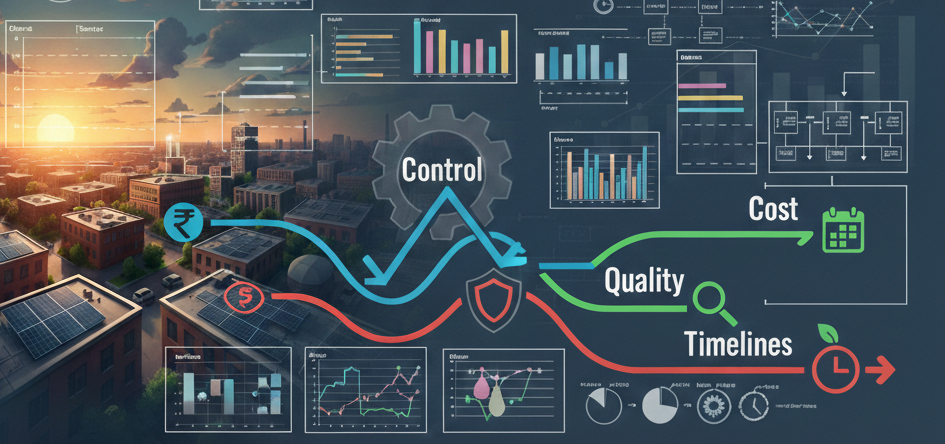
How to Control Cost, Quality, and Timelines in Multi-Site Solar Projects
Managing multi-site solar projects is fundamentally different from executing a single large plant. The complexity does not increase linearly; it multiplies. Costs, quality, and timelines are interlinked, and a failure in one almost always cascades into the others.
The first pillar of control is standardization. Multi-site projects demand standardized designs, BOQs, vendor scopes, documentation formats, and execution checklists. Without standardization, each site becomes a new problem, increasing engineering hours, procurement delays, and quality inconsistencies. Standardization does not mean rigidity—it means having controlled variants instead of reinventing solutions repeatedly.
The second pillar is front-loaded planning. Many delays originate before site work begins: incomplete surveys, unrealistic schedules, or unverified grid readiness. A realistic master schedule with site-wise micro-plans, logistics buffers, and regulatory dependencies is essential. Tools like MS Project or Jira are useful, but discipline in updating and reviewing them weekly matters more than the tool itself. Moreover, process efficiency matters most. Quoting a famous line as follows
Efficiency is doing things right; effectiveness is doing the right things.
Cost control in multi-site execution is primarily a procurement and logistics problem, not a construction one. Bulk procurement must be aligned with actual site readiness. Premature material dispatch increases damage, theft, and idle inventory costs. Vendor contracts should include delivery flexibility, penalty clauses, and performance-linked payments to align interests.
Quality control requires process ownership, not inspection alone. Clear installation SOPs, mandatory checklists, photographic documentation, and remote quality audits significantly reduce rework. Training site teams early is cheaper than fixing mistakes later.
Ultimately, success in multi-site solar projects comes from systems thinking—where planning, procurement, execution, and monitoring work as one integrated engine rather than isolated functions.