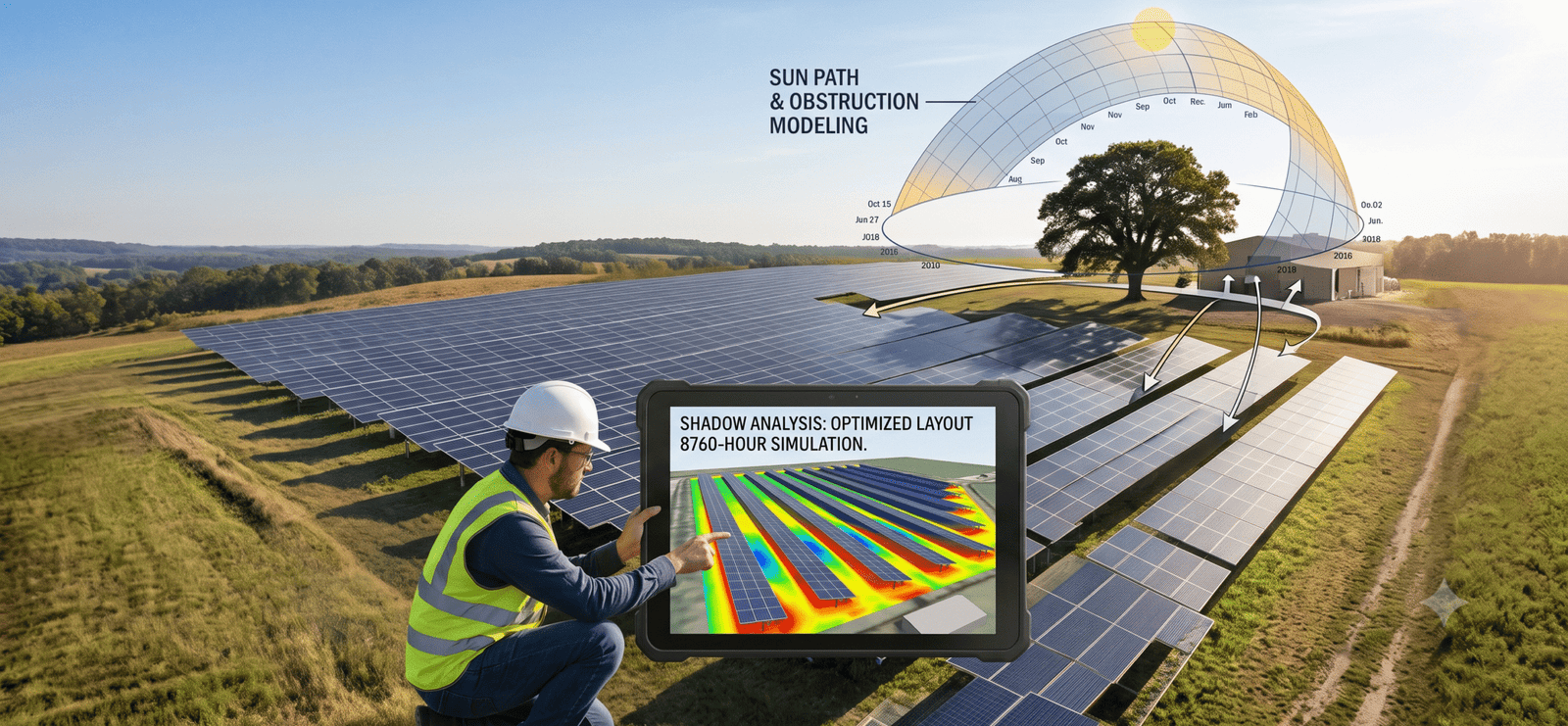
Shadow analysis in most Indian solar projects is still treated like a checkbox. A few calculations, maybe a quick simulation, and then the layout is frozen. But in reality, shadow is one of those things that quietly decides long-term performance—and most of the time, it’s not even analysed properly.
At a basic level, everyone knows the standard relationship:
H = L x tan(θ)
Where H is the perpendicular distance between upper edge of the solar panel to lower edge and θ is the solar elevation angle. When the solar panel is ideally be tilted at latitude angle θ of the location installed facing true south. This gives the shadow length. Based on this, inter-row spacing is usually decided using a worst-case assumption—typically winter conditions.
That’s fine as a starting point. But this is also where most designs stop.
What is usually ignored is that shadow is not just about length—it’s about direction.
Take a simple case: designing based on shadow at 4 PM. At that time, the sun is no longer due south. It has shifted towards the west, meaning the solar azimuth angle (φ) becomes significant. But most spacing calculations still assume that shadow falls straight behind the row, which is not true.
In reality, the shadow is inclined. So what actually matters is not the full shadow length, but its projection in the row-normal direction (north–south for south-facing systems).
That gives us:
S = (H / tan(θ)) × cos(φ)
This small correction changes the thinking completely.
At 4 PM, even though the total shadow length is large (because θ is low), the effective shadow behind the row reduces due to azimuth. In practical terms, this means:
- You don’t always need as much spacing as conservative assumptions suggest
- Land utilization can be improved
- DC capacity can be optimized without increasing real shading losses
This is especially useful in land-constrained or high-cost sites.
But this is also where caution is required.
This approach works well for understanding behavior and optimizing layouts, but it is still a single time snapshot. At solar noon, when the sun is almost due south, φ ≈ 0, and your correction disappears. That is often the condition where shadow directly impacts the next row.
So the goal is not to design only for 4 PM—it is to understand how shadow behaves across time.
And this is where modern tools become essential.
Using SketchUp or PVsyst shading scenes, you move beyond formulas into actual simulation. You can model:
- Real table geometry
- Parapets, water tanks, and HVAC units
- Terrain variations
- Full-year sun path
Instead of asking “Will this row shade the next?”, you start asking:
“How much annual energy am I losing because of this layout?”
That shift is critical.
In many Indian rooftop projects, shading from small obstructions is ignored because each one seems insignificant. But when combined with suboptimal spacing or azimuth deviation, the losses are no longer negligible.
Modern shadow analysis is not about eliminating shadows completely—that’s rarely practical. It’s about quantifying them and making informed trade-offs between:
- Installed capacity (kWp)
- Actual generation (kWh)
- Project economics
In my experience, the difference between an average design and a well-optimized one often comes down to this: whether shadow was treated as a formality or as a design driver.
Shadow is not just geometry.
It’s performance.