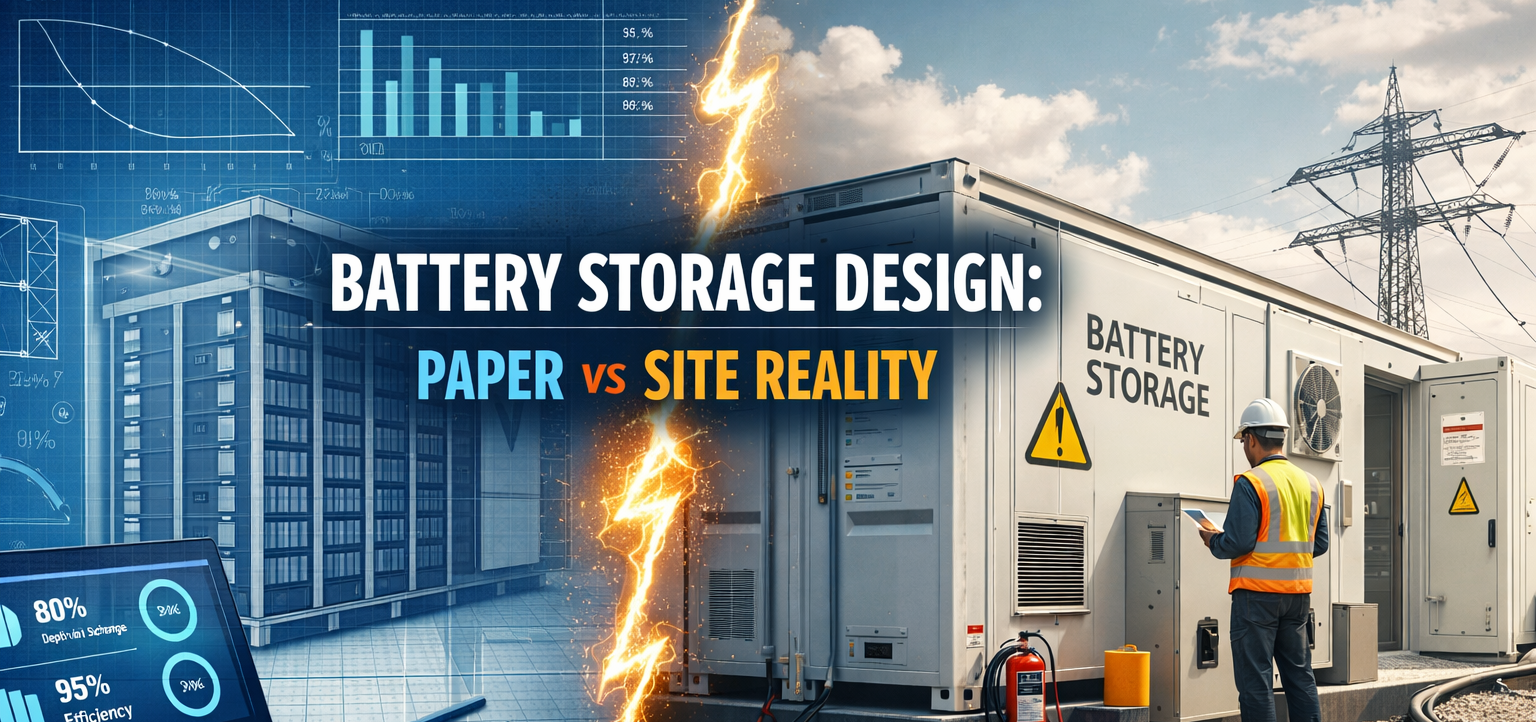
Battery Storage Design: What Looks Good on Paper vs Site Reality
Battery storage systems often look elegant in simulations but become far more complex when confronted with site realities. The gap between paper design and execution is where many storage projects struggle—not because the technology is weak, but because assumptions are too optimistic.
On paper, parameters like depth of discharge, cycle life, temperature range, and round-trip efficiency appear straightforward. In reality, thermal management, ventilation, and ambient site conditions play a decisive role in battery performance and longevity. Poor enclosure design, inadequate airflow, or exposure to high temperatures can drastically reduce battery life, regardless of what the datasheet promises.
Another major mismatch arises in load behavior assumptions. Design models often assume smooth, predictable load profiles. Real-world loads are rarely that disciplined. Sudden demand spikes, harmonics from non-linear loads, or unplanned capacity expansion can push battery systems beyond their intended operating envelope. Over time, this accelerates degradation and increases the risk of failure.
This is where execution teams are reminded of a fundamental engineering truth:
“All models are wrong, but some are useful.”
Battery simulations are useful, but only when designers acknowledge their limitations. Treating models as reality instead of approximation is one of the fastest ways to create long-term reliability issues.
Maintenance and operational accessibility is another area that is frequently underestimated. Battery systems are not “install and forget” assets. They require safe access, clear labeling, proper isolation, fire detection and suppression systems, and trained personnel. Designs that prioritize compactness over serviceability may look efficient on drawings but create serious operational and safety risks over the project lifecycle.
Grid interaction and protection coordination also behave differently on site. Earthing quality, relay coordination, communication latency, and inverter response times influence system stability far more than theoretical calculations suggest. Minor deviations in grounding resistance or signal delays can cause nuisance tripping or unstable operation, especially in hybrid or grid-support applications.
Successful battery storage projects demand design humility. Accepting that site conditions are imperfect leads to more conservative assumptions, better redundancy, and realistic safety margins. Systems designed with flexibility—rather than theoretical perfection—consistently outperform those optimized only on paper.
In energy storage, the difference between a reliable asset and a problematic one is rarely the chemistry. It is the willingness to respect site reality over spreadsheet confidence.